
For more than a century, May Morris has been introduced to the world as somebody's daughter. The Lady Lever Art Gallery in Port Sunlight is trying to fix that. May Morris: Crafting a Legacy, running now until 1 November 2026, is a full-scale look at a woman who ran a successful design business, championed working women, and shaped the Arts and Crafts movement in her own right, quite apart from the shadow cast by her father, William Morris.
Developed in partnership with the William Morris Society and drawing on loans from the Victoria and Albert Museum, the exhibition gathers embroidery, wallpaper, jewellery, drawings and archival material that together make the case for May as a maker and businesswoman worth studying on her own terms, not as a footnote to Morris & Co.
From Red House to the Workroom Floor
May Morris was born in 1862 at Red House, the Kent home her father built with Philip Webb, and grew up surrounded by her parents' circle of Pre-Raphaelite friends, including Dante Gabriel Rossetti, who sketched her as a child. It was an unusually creative household even by the standards of Victorian artistic families, and May was pulled into the family trade early, helping with her father's embroidery, carpet and wallpaper designs almost as soon as she could hold a needle.
She went on to study embroidery formally at the National Art Training School in London, later absorbed into the Royal College of Art, before taking on a role that would define her career: at just 23, she was made manager of Morris & Co.'s professional embroidery workroom. It was a serious position for a young woman to hold in the 1880s, and May used it to expand the embroidery side of the business substantially, building a working environment that, notably, created real opportunities for women, including working-class girls recruited from a local London
A Designer and an Advocate
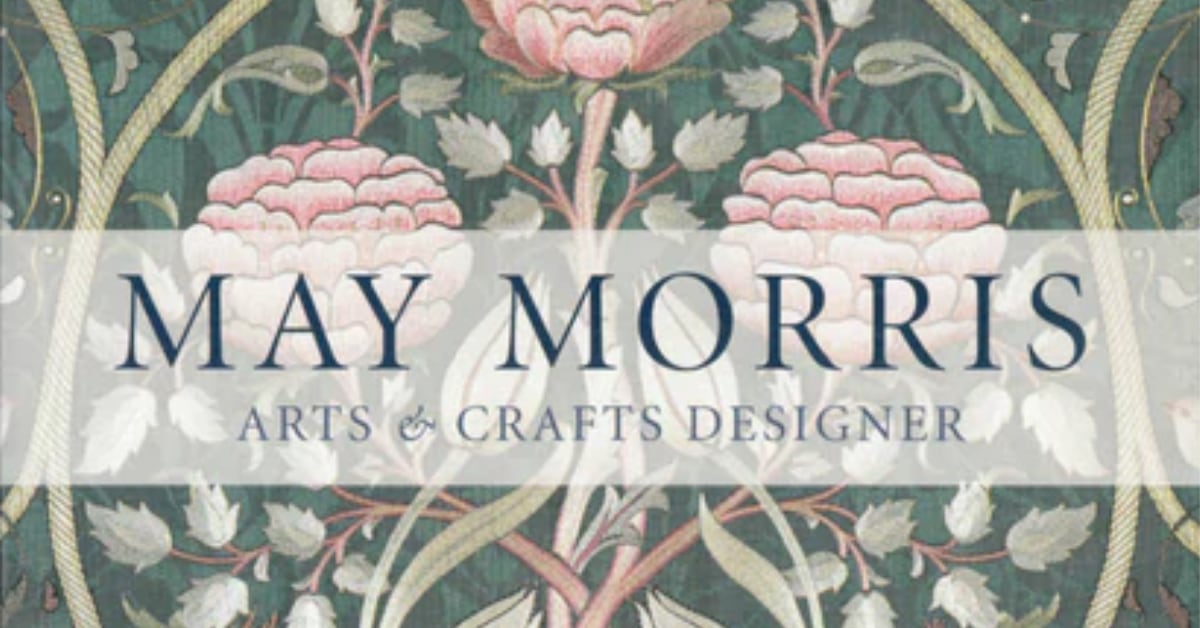
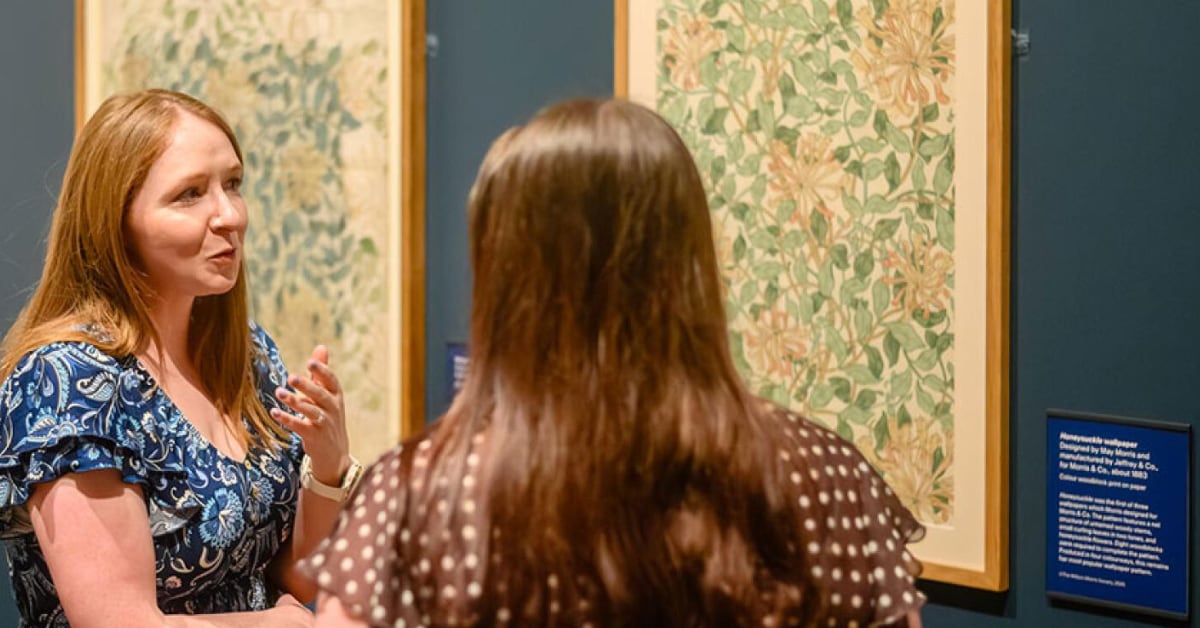
The exhibition doesn't separate May's design work from her politics, and rightly so, the two were never really separate for her. She supervised production of the household textiles she designed in the Morris & Co. style, shown in the company's Oxford Street showroom, with pieces like Honeysuckle, Horn Poppy and Arcadia among her own creations. Honeysuckle in particular has had a longer life than most Victorian textile designs: it's still produced today as wallpaper, fabric and homewares, and serves as a literal backdrop within the exhibition itself.
Away from the workroom, May co-founded the Women's Guild of Arts to support women working in a male-dominated field, a direct, practical response to the exclusion she saw around her rather than a symbolic gesture. She carried that same instinct into her personal life as an ardent socialist: she founded an early branch of the Women's Institute at Kelmscott, the Oxfordshire village associated with her childhood home, campaigned on local issues, ran a soup kitchen, and gifted coal to families in need during hard winters. It's a side of her biography that rarely makes it into design history books, and the Lady Lever's decision to include it is one of the show's real strengths.
What's Actually on Display
Crafting a Legacy pulls together drawing and painting, embroidery, wallpaper, fabric and jewellery alongside related craft and design work by other artists, spanning three centuries of context around May's own output. Among the more personal items are an early sketch of a young May by Rossetti and a bronze bust of her from 1910, made once she was firmly established in her own right, along with books on her father's work that she edited and helped bring to a wider readership after his death.
Fiona Slattery Clark, Curator of Decorative Art at National Museums Liverpool, put it plainly: the exhibition explores "the remarkable talents and personal achievements of May Morris, whose legacy has been overlooked for many years," adding that her advocacy for women's artistic practice "remains relevant to this day." That framing matters, this isn't a nostalgia show about Victorian craft, it's an argument for reassessing who gets credited with shaping a movement.
Why It Matters Beyond Port Sunlight
There's an obvious local angle here for anyone working in or teaching craft and design on Merseyside and Wirral: May Morris's career is a genuinely useful case study in running a creative business on your own terms, managing a workshop, training staff, and using a design practice as a platform for advocacy rather than treating the two as separate concerns. That's as relevant to a working textile artist or small studio today as it was in the 1880s.
It's also a reminder that some of the most significant correctives in art history happen quietly, in a regional gallery, rather than in a blockbuster London retrospective. Port Sunlight isn't a bad place for that kind of rebalancing to happen either, the model village itself has its own complicated relationship with Victorian ideas about work, welfare and craft.
Plan Your Visit
May Morris: Crafting a Legacy runs at the Lady Lever Art Gallery, Port Sunlight, Wirral, until 1 November 2026. Entry is free. The gallery is easily reached from Liverpool via the Mersey rail network and is well worth combining with a wider look at Port Sunlight's Arts and Crafts-era architecture, since the village itself grew out of many of the same ideals the exhibition explores.
Opening hours and any bookable events tied to the exhibition are best checked directly on the National Museums Liverpool website before travelling, as these can vary through the run.