Selling a piece of artwork is a major milestone for any artist. However, a sale is only truly successful when the art arrives in perfect condition. Transporting fragile, valuable artwork presents distinct challenges. Rapid sorting hubs, manual handling, varying humidity levels, and strict transit insurance exclusions all contribute to a distribution nightmare. In this article, we share some top tips for packaging and distributing artwork in the UK.
A standard "fragile" sticker will not protect a delicate watercolour, a heavy stretched canvas, or a sensitive charcoal drawing from the mechanical realities of modern courier networks. To safeguard your sales and your reputation, you need to scrutinise every aspect of your packaging and distribution methodology, adapting it according to the specific medium of the artwork. A delicate, glass-framed watercolour, a stretched canvas oil painting and a ceramic composition all need very different handling.
1. Medium-Specific Packing Protocols
Different art mediums react uniquely to pressure, static, moisture, and friction. Below are the definitive packing protocols for the most common mediums sold across the UK.
Watercolours, Pastels, and Charcoals
Works on paper framed under glass are most vulnerable to damage during shipping and need the most careful preparation. There are two main risks: internal friction and electrostatic charges ruining fragile media, and external impacts shattering the glass, which will systematically shred the artwork underneath. While using an acrylic glazing material can mitigate the risk of breakage, it comes with its own risk profile.
- The Medium Frontier: For unframed or pre-framed pastels and charcoals, never allow plastic, bubble wrap, or standard tissue to touch the surface. These materials generate static electricity, which literally lifts pigment particles off the paper. Always overlay the artwork with a sheet of acid-free, unbuffered glassine paper. Secure it firmly so it cannot slide back and forth, which causes smudging.
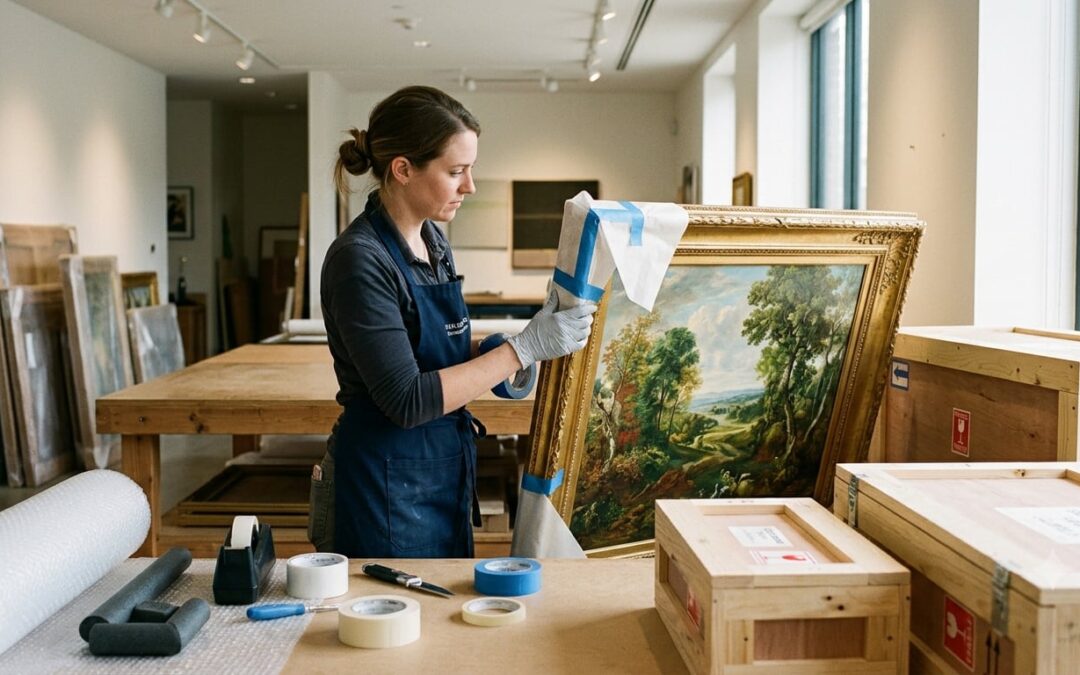
- The Glass Protection Protocol: If the artwork is framed under glass, you must apply glass protection tape (low-tack painter's tape or dedicated glass masking film) across the entire pane. Lay the tape in a dense, tight grid or a series of overlapping 'X' patterns from corner to corner. If the glass shatters under impact, the low-tack adhesive holds the shards together, preventing them from piercing the paper.
- The Acrylic Glazing Warning: Never use standard glass protection tape on acrylic glazing (Plexiglas), as the adhesives can chemically react with or scratch the plastic surface. Be very careful to ensure no adhesive tape touches the acrylic surface.
Stretched Canvasses
The unique design of stretched canvas artwork makes it highly susceptible to warping if it is exposed to uneven pressure, while the taut canvas itself is easily punctured or otherwise damaged.
- Puncture Defences: The vulnerable reverse and face of the canvas must be mechanically protected. Cut two sheets of heavy-duty, double-walled corrugated cardboard or foam core to the exact outer dimensions of the stretcher frame. Sandwich the canvas between these two sheets and secure them with tape along the wooden edges. This creates an impenetrable shield against sharp objects or corner punctures from adjacent parcels.
- Corner Defences: Never allow the corners of the canvas to absorb structural impacts. Use high-density foam U-channel edge protectors or construct thick cardboard corner bumpers. These must extend past the corner of the art to ensure a clear air gap between the frame and the outer shipping box.
Framed Acrylics
Acrylic paint is thermoplastic; it remains flexible and becomes soft or tacky at warm temperatures, while turning brittle in cold weather.
- Surface Safety: Because acrylic surfaces bond easily to smooth plastics under pressure, wrapping a bare acrylic painting directly in bubble wrap is a critical error. The bubbles can leave permanent, circular indentations on the paint film.
- The Barrier Layer: Wrap the framed acrylic completely in non-stick glassine paper or a smooth, non-woven archival polyolefin wrap (such as Tyvek) before adding any cushioning layers. These barrier layers help your artwork tolerate temperature variations that occur during overnight transit in cold courier vans or waiting in warm sorting warehouses and distribution centres.
Unusual Shapes and Three-Dimensional Media
Sculptures, ceramics, and mixed-media assemblages with irregular protrusions cannot be packed using flat box methods. They require total immobilisation.
- The Double-Box Method: This is the gold standard for shipping items of unusual shapes. First, wrap the object securely in tissue paper, followed by a generous layer of small-bubble wrap to fill any structural voids. Place this item inside a tight-fitting inner box, then anchor it firmly using crumpled kraft paper or eco-friendly packing peanuts, so it cannot shift in any direction.
- The Outer Suspension: Place this inner box inside a significantly larger outer box (allowing a minimum of 10 cm of clearance on all six sides). Fill that 10 cm perimeter entirely with tightly packed, high-density void fill. If the outer box is dropped or pierced, the shock wave dissipates through the void fill before reaching the inner enclosure.
2. A Step-by-Step Boxing and Sealing Guide
Once your artwork is safely wrapped in its medium-specific barrier layer, follow these simple steps to build a structurally sound shipping container to protect your precious artwork during shipping.
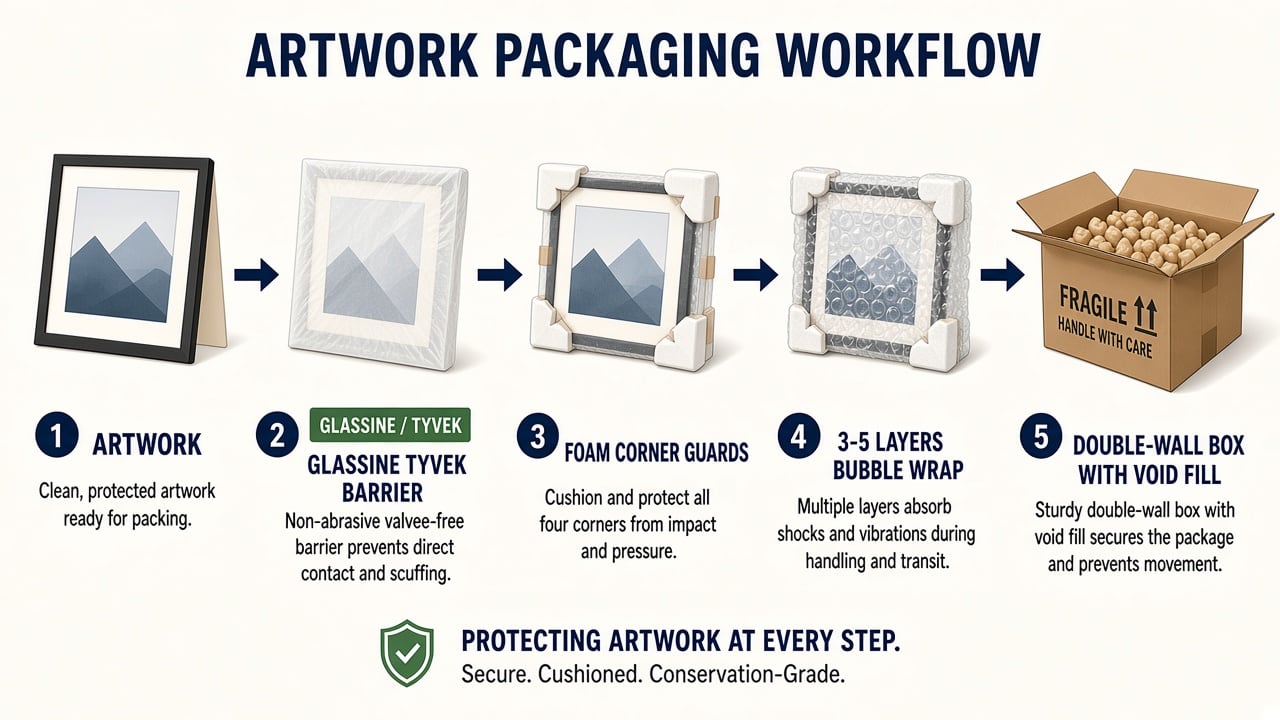
Step 1: Corner and Edge Protection
Apply heavy-duty foam, felt, or engineered cardboard corner protectors to the four corners of the frame or canvas sandwich. Secure them firmly with stretch wrap or painter's tape. Be careful to ensure no adhesive touches the artwork or frame finish.
Step 2: Shock Absorption
Wrap the entire unit in 3 to 5 layers of heavy-duty, large-bubble wrap. Secure the seams with high-quality packaging tape. Remember that the bubbles should face outward to ensure a smooth, uniform surface rests against your primary barrier layer.
Step 3: Container Selection
Always use a new, heavy-duty double-walled corrugated cardboard box to ship your artwork. Reused boxes lose up to 50% of their structural strength after a single journey. Specialised telescopic picture boxes or wrap mailers are ideal because they adjust perfectly to the depth of the frame, minimising internal movement.
Step 4: Internal Cushioning
Line the bottom of the box with a 5 cm layer of crushed packing paper or dense foam blocks. Then insert the wrapped artwork vertically. Using crushed paper or foam blocks, tightly fill all the remaining spaces so your artwork is securely positioned. Before sealing, perform the shake test: gently shake the box. If you feel or hear any internal movement or shifting, reopen the box and add more packaging to prevent any movement.
Step 5: Secure Box Sealing
Seal all seams of the outer box using the 'H-taping' method: Apply a continuous strip of heavy-duty vinyl or reinforced paper packaging tape across the centre seam of the box flaps. Then seal the side edges to create an airtight structural 'H' shape. Do this on both the top and bottom of the box.
3. Navigating Couriers and Specialist Networks
Choosing the right carrier for your artwork can be difficult, and there is no one 'right' choice. Rather, the most appropriate carrier depends directly on the item's financial value and its structural fragility. The UK market splits cleanly into standard parcel networks, suited to low-value and more robust items, and dedicated fine art couriers specialising in shipping fragile, high-value, artworks.
Standard Network Carriers
If your artwork is valued under £500, is sturdily packed, and does not feature oversized glass, high-volume standard delivery networks can provide a fast, trackable transit service.
| Courier Service | Best Used For | Tracking & Reliability | Key Limitation |
| DPD | High-value standard prints; reliable time-slots. | Outstanding tracking; precise 1-hour delivery windows. | Strict size/weight limits; no compensation for fine art. |
| Parcelforce (Worldwide) | Large canvases; regional UK deliveries | Highly dependable tracking across remote UK zones. | Manual sorting can be rough on fragile frames. |
| APC Overnight | Awkwardly shaped or fragile smaller domestic items. | Excellent regional network; lower parcel volumes per van. | Drop-off locations are more limited than competitors. |
Specialist Art Couriers
For delicate items, large-scale projects, or pieces valued over £1,000, the standard delivery networks pose an unacceptable risk. Specialist art couriers transport your work using dedicated, climate-controlled vehicles, with minimal handling.
- Pack & Send: Operates physical service centres across the UK. They provide an end-to-end service where they professionally pack, custom-crate, and ship the art under their proprietary Loss and Damage Warranty, which covers fine art, ceramics, and glass without the standard carrier exemptions.
- Aardvark Art Services: Based in Cheshire but operating nationwide, Aardvark operate scheduled, secure art transport runs across the UK. They use unmarked, temperature-regulated vehicles driven by trained art handlers to offer a safe and secure delivery service.
- Van Go Art Couriers: Provide an excellent service for direct artist-to-collector deliveries. Van Go operate dedicated multi-stop routes across the UK. Your artwork stays on the same vehicle from collection to final delivery, minimising the handling of your artwork and its associated risks.
4. Transit Insurance, Compensation, and Legalities
Misunderstanding courier liability profiles is probably the most common financial pitfall for UK art sellers.
The Standard Courier "Prohibited / Excluded" Trap
If you read the terms and conditions of mainstream UK couriers (such as Evri, Yodel, DPD, or Royal Mail), "Fine Art", "Antiques", "Glass", and "Ceramics" are systematically listed on their Compensation Exclusion lists.
This means that while a courier might willingly accept your parcel and charge you for premium tracking or standard transit insurance, they will deny any financial claim if the glass shatters or the painting is damaged in transit. They will only pay out if the entire parcel is physically lost within their network.
Third-Party Art Insurance Solutions
If you regularly ship high-value work via standard networks, it is unwise to rely on carrier add-ons. Look into dedicated business insurance policies or temporary transit policies via specialist providers (such as Hiscox UK Art Insurance or specialised art broker policies). These policies are specifically designed for the art market of usually cover things like:
- Depreciation Cover: Pays out if a piece is damaged, repaired, and subsequently loses a percentage of its original market value.
- True Title and Consignment Cover: Insures the item for its full retail sale value, rather than just the raw material cost of the canvas and paint.
5. Summary Checklist for UK Art Sellers
Before booking any UK collection, verify your workflow against this quick operational checklist:
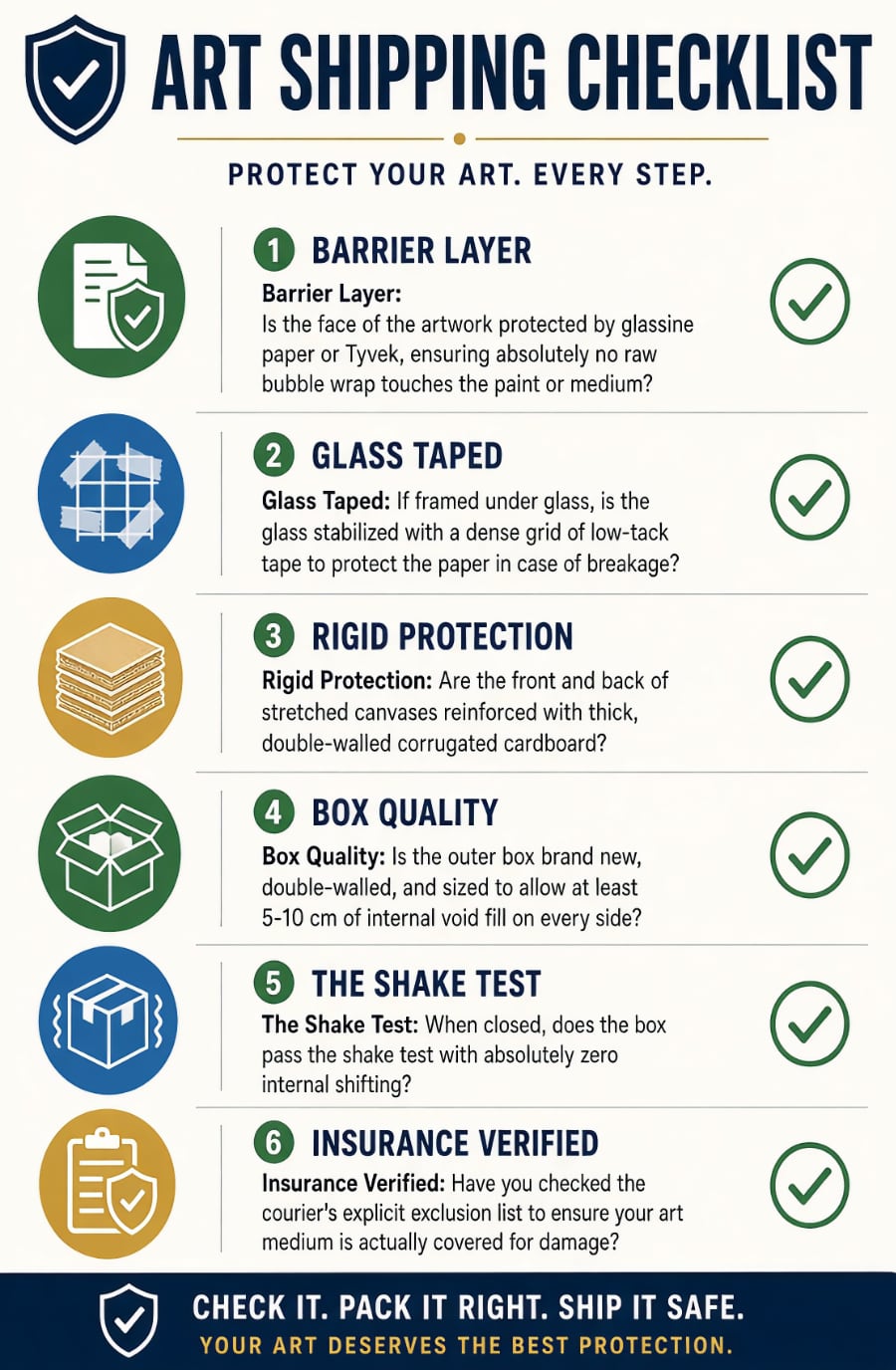
- Barrier Layer: Is the face of the artwork protected by glassine paper or Tyvek, ensuring absolutely no raw bubble wrap touches the paint or medium?
- Glass Taped: If framed under glass, is the glass stabilised with a dense grid of low-tack tape to protect the paper in case of breakage?
- Rigid Protection: Are the front and back of stretched canvases reinforced with thick, double-walled corrugated cardboard?
- Box Quality: Is the outer box brand new, double-walled, and sized to allow at least 5-10 cm of internal void fill on every side?
- The Shake Test: When closed, does the box pass the shake test with absolutely zero internal shifting?
- Insurance Verified: Have you checked the courier's explicit exclusion list to ensure your art medium is actually covered for damage?